




Open 10:00–18:00

Details
-
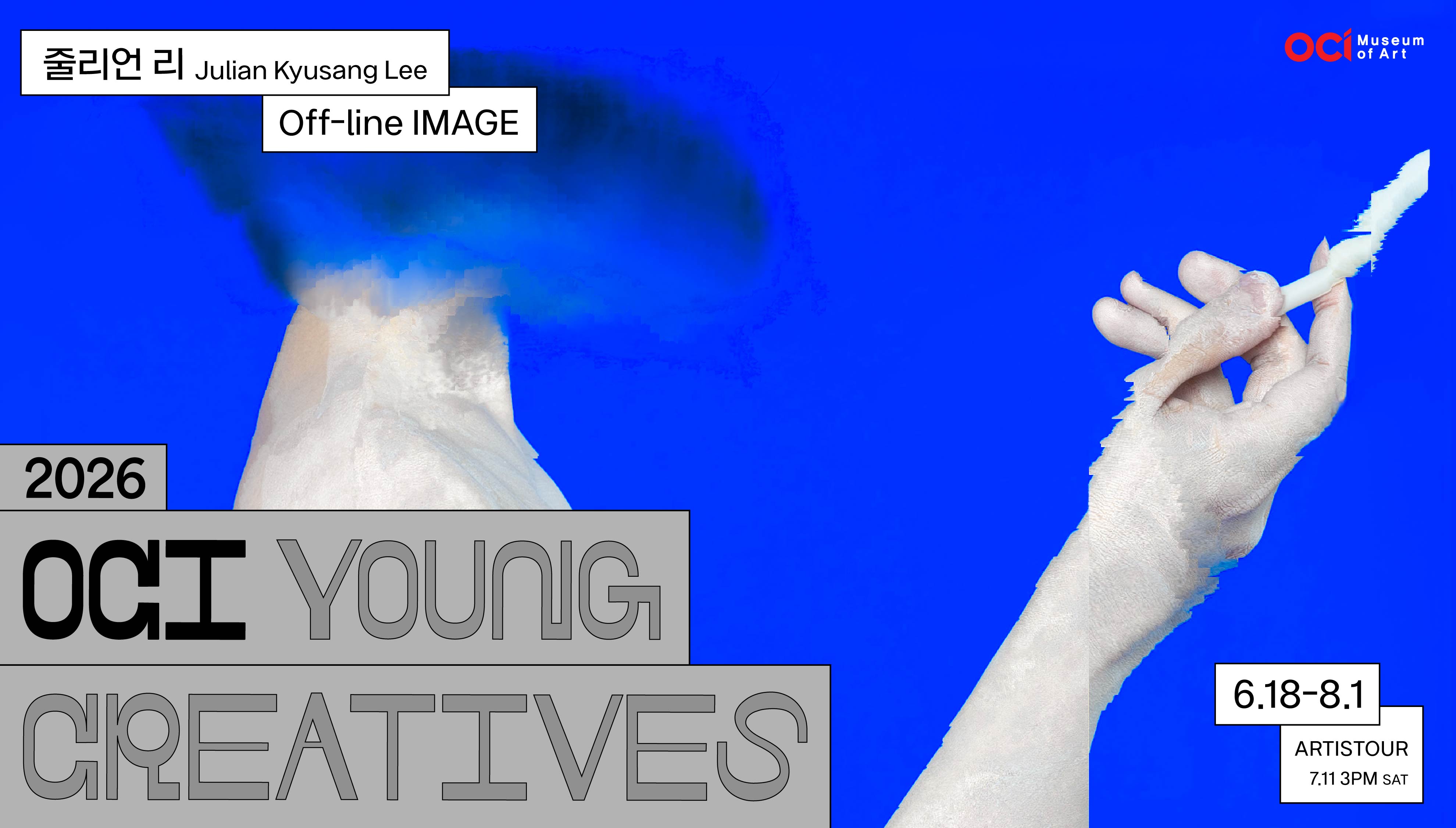
Artist
Julian Kyusang Lee -
Exhibition Title
《Off-line IMAGE》 -
Date
2026. 06. 18 - 08. 01 -
Venue
OCI Museum of Art
Curatorial Statement
In defense of the invisible
When it comes to photography, most artists’ primary interest is in the
way that images are seen and captured – how variables like light, depth of
field, scale, composition and context influence our perception. But what about
images that are not meant to be seen at all? Images designed to be invisible,
overlooked or misread?
Such concerns are central to the multidisciplinary art practice of Julian
Kyusang Lee, whose creative outlook is indelibly tethered to a worldview shaped
by personal experience. Born in Seoul, Lee spent his formative years as an
adolescent in Cape Town, South Africa, where he and his younger brother were
the only Asian students at their school. While South Africa is by no means an
ethnically homogeneous country, the cultural and linguistic differences between
Lee and his classmates were particularly pronounced, making him constantly
aware of his status as an interloper. Years later, Lee would face similar circumstances
after moving to Germany to attend the Leipzig Academy of Fine Arts, where his
artistic philosophy was forged in response to his identity as a perpetual
outsider.
A key motif throughout Lee’s early oeuvre from this period derives
from chroma key, a technique for compositing multiple images into a single
frame, typically using a green screen. The chroma key process isolates a
photographic subject from its background, which is later replaced with another
image in post-production so that the original background is rendered invisible.
By inserting abstract green forms into his images, Lee visualizes that which is
destined to remain unseen, a posture that he found increasingly resonant amid the
Western milieux of South Africa and Germany. His chroma key works thematize the
precarious sensibility of living on the periphery, thereby implicating dominant
modes of visual perception and the social conditioning upon which they are
premised. For Lee, the constant confrontation of one’s own image being
neutralized in the public gaze led to a natural predilection for challenging the
status quo.
Foregrounding something like chroma key – which has become so
ubiquitous in contemporary visual culture that there is even a specific shade
on the Pantone spectrum which serves as the industry standard – is a shrewd strategy
that drives to the heart of Lee’s critical inquiry into the role of images in today’s
society. Who decides what we see, and on what basis? At what point is an image
considered complete, in other words, suitable for distribution and consumption?
And what is the fate of images that are systematically forbidden from entering
the public sphere? Considering such questions, Lee’s appropriation of photographic
focus charts as a secondary visual motif assumes newfound urgency, presenting
these anodyne tools of the trade as polemical subjects unto themselves.
The abstract, greyscale compositions of focus charts convey
indeterminate depths of meaning. To photographers, they serve as essential
implements for establishing a precise depth of field through their lens and thereby
reducing an element of guesswork within their workflow. They serve as tools for
imbuing photos with an unimpeachable sense of reality – tools which are always
removed from the frame before the final image is captured. Lee, however,
insists on presenting these temporary stand-ins as fully-fledged protagonists, often
unadulterated and without any context that might undermine their neutrality. Construed
as exhibition-ready images, they assert their own legitimacy and intrinsic
value as objects that are meant to be seen.
This is where topics of authorship and intention in Lee’s oeuvre enter
the broader cultural discourse regarding the origin of images and how their
meanings change over time. A fundamental symptom of living in an age when images
can be searched, cross-referenced and manipulated – and thus made to support
any number of predetermined interpretations – is the cognitive dissonance that
manifests whenever we are confronted with something that seems incompatible
with contemporary codification. Despite our efforts to distill visual stimuli
into neatly organized semantic categories, there are nonetheless incongruous
instances of man-made imagery that persistently resist such neural proclivities.
For all of us, certain images embody an irrational potency – whether
they touch something buried deep within our subconscious or are so
idiosyncratic that they compel a closer look, holding our gaze and gripping our
psyche. While the aforementioned cases may suffice as contemporary examples of
as-yet unresolved epistemologies of visual language, Lee grounds his most
recent foray into perceptual precarity in a source far removed from photographic
means of production. Rather than invoking the mechanical dimension of
image-making, he looks to the abstract iconography of Bronze Age inhabitants of
the Korean Peninsula, whose petroglyphs in the outskirts of present-day Ulsan
have proven inscrutable to modern-day scholars. These rock carvings are
singular in their non-representational imagery, particularly in contrast to other
nearby depictions of marine and land animals, delineating circular patterns
that seem to serve no practical purpose.
These images bespeak an untold truth. While they worldview
they reflect may be lost on our modern-day semantic lexicon, they remain
nonetheless valid as visual signifiers, even if their meaning remains illegible
to contemporary viewers. Their truth resonates with Lee on a visceral level, as
someone whose own story has so often been deemed extraneous. In his artworks,
imagery that would otherwise be expunged from the public eye assumes an
indispensable function in guiding the eye toward a more critical mode of
perception, one indiscriminate in its correlation to cognitive hierarchies, insisting
that anything which can be seen is deserving of equal attention, no matter how
unfathomable it may be.
-Andy St. Louis (Frieze House Director)
Julian Kyusang Lee
kyusangleestudio@gmail.com | www.kyusanglee.com | @kyusangleejulian
Education
2024 Meisterstudium, HfBK Dresden / HGB Leipzig, Prof. Christin
Lahr, Germany
2016 B.F.A., University of Cape Town, Republic of South Africa
Selected Solo Exhibitions
2026 Off-line IMAGE, OCI Museum of
Art, Seoul, Korea
2024 Ostinato Interstice Rendering, Techne Sphere,
Leipzig, Germany
Selected Group Exhibitions
2026 AETHER COMMONS:
Refracted Cosmologies, Fundacja
Stefana Gierowskiego, Warsaw, Poland
2024 Dior Photography and Visual
Arts Award for Young Talents,
LUMA Arles, France
Gute Aussichten – Junge Deutsche Fotografie 2024/25, Deichtorhallen Hamburg; Landesmuseum Koblenz; Städtische
Galerie Karlsruhe, Germany
2022 Documenta fifteen, Kassel,
Germany
2019 Still Here Tomorrow To High Five
You Yesterday…, Zeitz Museum of Contemporary Art Africa, Cape Town, Republic
of South Africa
Awards / Honors
2025 Selected as 2026 OCI YOUNG CREATIVES, OCI Museum of Art, Seoul
Gute Aussichten – Junge Deutsche Fotografie (New German Photography Award), Germany
2024 Dior Photography and Visual Arts Award for Young Talents. France
2023 Ketterer Kunst Masterclass Preis für Junge
Kunst, Germany
2020 Minister of National Defense
Award, Korea
2017 Celeste Prize,
Photography Category, London,
United Kingdom
Grants
2024 Kulturstiftung des Freistaates Sachsen, Germany
Collections
Zeitz Museum of Contemporary Art Africa, Cape Town, Republic
of South Africa


